Showing 1–16 of 51 resultsSorted by latest

  • Tork Craft Diamond Blade 230Mm Segmented Profesional 25Pc Bulk

    Tork Craft Diamond Blade 230Mm Segmented Profesional 25Pc Bulk

    R3 846,99


    Segmented Professional Diamond Blades 25pc – Bulk

    Diameter: Ø230mm

    <!-- -->

    The Diamond Blades 230mm Segmented Professional 25pc offers exceptional performance and value for demanding cutting
    tasks. Each 230mm blade features a segmented rim design, engineered for efficient debris removal and cooler
    operation, which extends blade life and maintains cutting speed through a variety of tough materials like concrete,
    masonry, and stone. Crafted for professional use, this bulk pack of 25 blades ensures you have a reliable supply on
    hand for extensive projects, minimizing downtime and maximizing productivity on the job site.

    Application:

    • Screed
    • Clay
    • Brick
    • Mortar
  • Tork Craft Diamond Blade 300 X 25.4Mm Asphalt Laser Welded Segmented Tar

    Tork Craft Diamond Blade 300 X 25.4Mm Asphalt Laser Welded Segmented Tar

    R2 725,41

    Diamond blade


    TYPE:

    Laser weld and segmented

    DIAMETER: ø300mm
    BORE: Ø25.4mm
    MAX RPM: 5,000
    USE: Asphalt

    What is a diamond blade?

    A diamond blade is composed of a circular steel core and the diamond
    impregnated segments. The segments are seperated by slots in the core.

    These
    slots assist in cooling the blade during operation by allowing water (wet
    cutting) or air (dry cutting) to flow between the segments. The segments or rims
    are a mixture of diamond powder and metal powders. The diamonds are industrial
    diamonds of different sizes and qualities depending on the material to be cut as
    well a the blade type.

    How does a diamond blade work?

    The individual diamond crystals exposed on the leading edge and the sides of
    the segment or rim carry out the cutting. The operator pushes the rotating blade
    into the material and the surface diamonds thus exposed mill a groove in the
    material. When the blade mills the material, the latter exerts wear on the
    blade. During cutting the exposed diamonds may crack
    or break. The material simultaneously starts to abrade the metal matrix, which
    releases more diamonds.

    The more abrasive the material, the more rapid
    the tendency to wear down the matrix. Blades for cutting hard, denseless
    abrasive materials (such as tile, bricks, stone or cured concrete), require
    a softer metal matrix.

    This will wear down faster, replacing the worn diamonds
    fairly quickly so that the blade continues to cut.

    Blades for cutting soft,
    abrasive materials (such as green concrete and asphalt), must have  a hard,
    abrasion-resistant metal matrix in order to retain the diamonds for a longer
    time.

    Water will prevent the blade from overheating:

    It will greatly reduce the amount of harmful dust created by cutting. Remove the
    slurry from the cut, and extend the life of the blade.

  • Tork Craft Diamond Blade 350X25.4Mm Concrete Laser Welded Segmented

    Tork Craft Diamond Blade 350X25.4Mm Concrete Laser Welded Segmented

    R2 606,33

    Diamond blade


    TYPE:

    Laser weld and segmented

    DIAMETER: ø350mm
    BORE: Ø25.4mm
    MAX RPM: 4,300
    USE: Old concrete

    What is a diamond blade?

    A diamond blade is composed of a circular steel core and the diamond
    impregnated segments. The segments are seperated by slots in the core.

    These
    slots assist in cooling the blade during operation by allowing water (wet
    cutting) or air (dry cutting) to flow between the segments. The segments or rims
    are a mixture of diamond powder and metal powders. The diamonds are industrial
    diamonds of different sizes and qualities depending on the material to be cut as
    well a the blade type.

    How does a diamond blade work?

    The individual diamond crystals exposed on the leading edge and the sides of
    the segment or rim carry out the cutting. The operator pushes the rotating blade
    into the material and the surface diamonds thus exposed mill a groove in the
    material. When the blade mills the material, the latter exerts wear on the
    blade. During cutting the exposed diamonds may crack
    or break. The material simultaneously starts to abrade the metal matrix, which
    releases more diamonds.

    The more abrasive the material, the more rapid
    the tendency to wear down the matrix. Blades for cutting hard, denseless
    abrasive materials (such as tile, bricks, stone or cured concrete), require
    a softer metal matrix.

    This will wear down faster, replacing the worn diamonds
    fairly quickly so that the blade continues to cut.

    Blades for cutting soft,
    abrasive materials (such as green concrete and asphalt), must have  a hard,
    abrasion-resistant metal matrix in order to retain the diamonds for a longer
    time.

    Water will prevent the blade from overheating:

    It will greatly reduce the amount of harmful dust created by cutting. Remove the
    slurry from the cut, and extend the life of the blade.

  • Tork Craft Diamond Blade 350X25.4Mm Green / New Concrete Laser Welded Segmented

    Tork Craft Diamond Blade 350X25.4Mm Green / New Concrete Laser Welded Segmented

    R2 493,75

    Tork Craft Diamond Blade — 350 × 25.4 mm Laser-Welded Segmented (New/Green Concrete)

    Size: 350 mm diameter [Bore: 25.4 mm (1″)]

    Built for fresh pours and green concrete, this 350 mm Tork Craft diamond blade uses laser-welded segments and a deep-gullet design to keep the kerf clear, cut cool and track straight. Ideal for structural slab work, expansion joints, trenching and utility chase lines where speed and durability matter.

    Note: Performs great with new concrete surfaces

  • Tork Craft Tct Blade Steel Cutting 355X66T 25.4Mm

    Tork Craft Tct Blade Steel Cutting 355X66T 25.4Mm

    R2 239,86

    Tork Craft TCT Blade Steel Cutting 355 x 66T 25.4mm

    Highlights: 355mm diameter steel-cutting TCT blade with 66 teeth and 25.4mm bore for fast, clean ferrous-metal cuts.

    When you need steel to behave, this Tork Craft TCT Steel Cutting Blade steps up. With a big 355mm diameter and a dense 66-tooth layout, it’s tuned for smooth, controlled cutting in mild steel and other ferrous metals. The tungsten-carbide-tipped (TCT) teeth stay sharper for longer, giving you consistent performance and a cleaner finish than standard abrasive solutions. Whether you’re in a workshop, fabrication bay, or on-site with a compatible steel-cutting saw, this blade is built to chew through metal confidently while keeping the cut line tidy and true.

    High-tooth-count TCT steel blade for cleaner, cooler ferrous-metal cutting

    The 66T configuration helps reduce burrs and improves cut quality, making it ideal for repeatable, professional results.

  • Tork Craft Diamond Blade 350X25.4Mm Old Concrete Laser Welded Segmented

    Tork Craft Diamond Blade 350X25.4Mm Old Concrete Laser Welded Segmented

    R2 227,66

    Tork Craft Diamond Blade — 350 × 25.4 mm Laser-Welded Segmented (Old/Cured Concrete)

    Size: 350 mm diameter [Bore: 25.4 mm]

    Designed for heavy duty cutting of old or fully cured concrete, this 350 mm Tork Craft blade features a laser-welded segmented rim and a large diameter for deep cuts. Ideal for structural slab modifications, expansion joints, concrete paving, and large format concrete trimming.

    Note: Performs great with old/cured concrete surfaces

  • Tork Craft Diamond Blade 300 X 25.4Mm Green / New Concrete Laser Welded Segmented

    Tork Craft Diamond Blade 300 X 25.4Mm Green / New Concrete Laser Welded Segmented

    R2 121,54

    Tork Craft Diamond Blade — 300 × 25.4 mm Laser-Welded Segmented (New Concrete)

    Size: 300 mm diameter [Bore: 25.4 mm]

    This high-capacity 300 mm Tork Craft diamond blade features a laser-welded segmented rim engineered for new concrete cutting. With a robust steel core, deep gullet design for chip clearance and a 25.4 mm arbor bore, it’s built to excel on structural-grade concrete under demanding conditions.

  • Tork Craft Diamond Blade 350X25.4Mm Green / New Concrete Laser Welded Segmented

    Tork Craft Diamond Blade 350X25.4Mm Green / New Concrete Laser Welded Segmented

    R1 777,69

    Diamond blade


    TYPE:

    Laser weld and segmented

    DIAMETER: ø350mm
    BORE: Ø25.4mm
    MAX RPM: 4,300
    USE: Green concrete

    What is a diamond blade?

    A diamond blade is composed of a circular steel core and the diamond
    impregnated segments. The segments are seperated by slots in the core.

    These
    slots assist in cooling the blade during operation by allowing water (wet
    cutting) or air (dry cutting) to flow between the segments. The segments or rims
    are a mixture of diamond powder and metal powders. The diamonds are industrial
    diamonds of different sizes and qualities depending on the material to be cut as
    well a the blade type.

    How does a diamond blade work?

    The individual diamond crystals exposed on the leading edge and the sides of
    the segment or rim carry out the cutting. The operator pushes the rotating blade
    into the material and the surface diamonds thus exposed mill a groove in the
    material. When the blade mills the material, the latter exerts wear on the
    blade. During cutting the exposed diamonds may crack
    or break. The material simultaneously starts to abrade the metal matrix, which
    releases more diamonds.

    The more abrasive the material, the more rapid
    the tendency to wear down the matrix. Blades for cutting hard, denseless
    abrasive materials (such as tile, bricks, stone or cured concrete), require
    a softer metal matrix.

    This will wear down faster, replacing the worn diamonds
    fairly quickly so that the blade continues to cut.

    Blades for cutting soft,
    abrasive materials (such as green concrete and asphalt), must have  a hard,
    abrasion-resistant metal matrix in order to retain the diamonds for a longer
    time.

    Water will prevent the blade from overheating:

    It will greatly reduce the amount of harmful dust created by cutting. Remove the
    slurry from the cut, and extend the life of the blade.

  • Tork Craft Tct Blade Steel Cutting. 300 X 80T 30Mm Bore

    Tork Craft Tct Blade Steel Cutting. 300 X 80T 30Mm Bore

    R1 767,90

    Tork Craft TCT Blade Steel Cutting 300 × 80 T 30 mm Bore

    Large-format steel cutting blade: 300 mm diameter, 80-tooth carbide design for heavy ferrous material

    This Tork Craft TCT Blade is engineered for demanding steel-cutting tasks. With a 300 mm diameter and 80 precision carbide teeth, it slices through steel and other ferrous metals with consistency and durability. The 30 mm bore size allows mounting on standard commercial saws and cutting platforms equipped for 30 mm arbor fittings.

    The blade features a tempered steel body for smoother cutting and deep gutters for efficient chip removal, meaning less clogging and better performance under load. It’s ideal for metal fabrication workshops, structural steel cutting, maintenance shops and any setting where clean, fast cuts in steel are required.

    What makes a TCT (Tungsten Carbide Tipped) blade ideal for steel cutting?

    A TCT blade has teeth tipped with tungsten-carbide, which maintains sharpness and edge retention far longer than standard carbon steel blades when cutting hard materials like steel. The extra-tough construction withstands high temperatures and abrasive wear, making it suitable for dedicated metal-cutting environments.

  • Tork Craft Tct Blade Steel Cutting. 300 X 80T 25.4 Bore

    Tork Craft Tct Blade Steel Cutting. 300 X 80T 25.4 Bore

    R1 767,90

    Tork Craft TCT Blade Steel Cutting 300 × 80T 25.4 Bore

    Heavy-duty steel cutting blade: 300 mm diameter, 80-tooth TCT blade for ferrous metal work

    This Tork Craft TCT Blade is engineered for steel-cutting applications. With a robust 300 mm diameter and 80 precision tungsten-carbide teeth, plus a 25.4 mm bore for standard arbor mounting, it makes fast work of steel and other ferrous metals. Its heat-treated body, deep chip-removal gutters and reinforced shoulders minimise tooth loss and maximise durability.

    Ideal for fabricators, metal-work shops and on-site trades where hardened steel, sheet metal, structural sections or profiles must be cut smoothly and repeatedly, this blade delivers clean cuts with fewer passes and less burring, boosting productivity and saving tool-change time.

    What “TCT” means

    TCT stands for Tungsten Carbide Tipped: each tooth of this blade has a carbide tip to maintain cutting sharpness under high loads, high RPM and when engaging harder metals—extending life versus standard HSS or non-tipped blades.

  • Tork Craft Tct Blade Steel Cutting 305X80T 30Mm

    Tork Craft Tct Blade Steel Cutting 305X80T 30Mm

    R1 718,79

    Tork Craft TCT Blade Steel Cutting 305 × 80T – 30 mm Bore

    High-performance steel cutting blade: 305 mm diameter, 80 carbide teeth for fine finish and optimal productivity

    The Tork Craft TCT Blade Steel Cutting 305 × 80T – 30 mm Bore is built for demanding ferrous-metal cutting tasks where precision and durability matter. Its 305 mm size and 80 tungsten-carbide tipped teeth deliver fine, accurate cuts in steel, stainless steel and structural materials, while minimizing burr and secondary finishing.

    The 30 mm arbor bore ensures compatibility with many industrial saws, and the robust blade body along with engineered tooth geometry manage heat, vibration and cutting load to deliver consistent performance in metal fabrication shops, manufacturing lines and maintenance environments.

    What makes a TCT blade suited to steel cutting?

    TCT stands for Tungsten Carbide Tipped: each tooth is tipped with a carbide alloy that holds an edge far longer than standard steel teeth. This allows the blade to handle harder materials, higher heat build-up and faster cut cycles without rapid wear.

  • Tork Craft Tct Blade Steel Cutting 305X60T 30Mm

    Tork Craft Tct Blade Steel Cutting 305X60T 30Mm

    R1 521,00

    Tork Craft TCT Blade Steel Cutting 305 × 60T – 30 mm Bore

    High-capacity steel cutting blade: 305 mm diameter with 60 carbide teeth for fast, clean cuts in ferrous metals

    The Tork Craft TCT Steel Cutting Blade 305 × 60T is engineered for heavy-duty industrial cutting of steel and other ferrous metals. With a large 305 mm diameter and 60 precision-ground tungsten-carbide teeth, this blade delivers clean, controlled cuts with reduced burring and minimal heat distortion.

    Its 30 mm bore ensures compatibility with a wide range of metal-cutting circular saws, chop saws and cold-cut saw systems. The blade body is fully tensioned and precision-balanced to minimise vibration, giving smoother, safer performance in fabrication shops, production environments and on-site steelwork.

    Why choose a TCT blade for steel?

    TCT (Tungsten Carbide Tipped) teeth retain sharpness far longer than standard steel teeth. They resist heat, abrasion and impact—making them ideal for cutting harder materials like mild steel, angle iron, tubing, conduit and structural profiles.

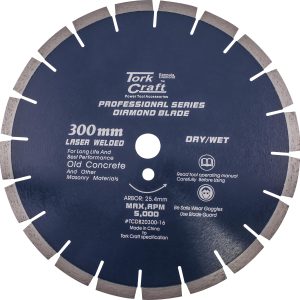
  • Tork Craft Diamond Blade 300 X 25.4Mm Old Concrete Laser Welded Segmented

    Tork Craft Diamond Blade 300 X 25.4Mm Old Concrete Laser Welded Segmented

    R1 427,71

    Diamond blade


    TYPE:

    Laser weld and segmented

    DIAMETER: ø300mm
    BORE: Ø25.4mm
    MAX RPM: 5,000
    USE: Old concrete

    What is a diamond blade?

    A diamond blade is composed of a circular steel core and the diamond
    impregnated segments. The segments are seperated by slots in the core.

    These
    slots assist in cooling the blade during operation by allowing water (wet
    cutting) or air (dry cutting) to flow between the segments. The segments or rims
    are a mixture of diamond powder and metal powders. The diamonds are industrial
    diamonds of different sizes and qualities depending on the material to be cut as
    well a the blade type.

    How does a diamond blade work?

    The individual diamond crystals exposed on the leading edge and the sides of
    the segment or rim carry out the cutting. The operator pushes the rotating blade
    into the material and the surface diamonds thus exposed mill a groove in the
    material. When the blade mills the material, the latter exerts wear on the
    blade. During cutting the exposed diamonds may crack
    or break. The material simultaneously starts to abrade the metal matrix, which
    releases more diamonds.

    The more abrasive the material, the more rapid
    the tendency to wear down the matrix. Blades for cutting hard, denseless
    abrasive materials (such as tile, bricks, stone or cured concrete), require
    a softer metal matrix.

    This will wear down faster, replacing the worn diamonds
    fairly quickly so that the blade continues to cut.

    Blades for cutting soft,
    abrasive materials (such as green concrete and asphalt), must have  a hard,
    abrasion-resistant metal matrix in order to retain the diamonds for a longer
    time.

    Water will prevent the blade from overheating:

    It will greatly reduce the amount of harmful dust created by cutting. Remove the
    slurry from the cut, and extend the life of the blade.

  • Tork Craft Diamond Blade Brazed 350 X 25.4Mm For Asphalt Tar

    Tork Craft Diamond Blade Brazed 350 X 25.4Mm For Asphalt Tar

    R1 361,54

    Diamond blade


    TYPE:

    Brazed and segmented

    DIAMETER: ø350mm
    BORE: Ø25.4mm
    MAX RPM: 3280
    USE: Asphalt

    What is a diamond blade?

    A diamond blade is composed of a circular steel core and the diamond
    impregnated segments. The segments are seperated by slots in the core.

    These
    slots assist in cooling the blade during operation by allowing water (wet
    cutting) or air (dry cutting) to flow between the segments. The segments or rims
    are a mixture of diamond powder and metal powders. The diamonds are industrial
    diamonds of different sizes and qualities depending on the material to be cut as
    well a the blade type.

    How does a diamond blade work?

    The individual diamond crystals exposed on the leading edge and the sides of
    the segment or rim carry out the cutting. The operator pushes the rotating blade
    into the material and the surface diamonds thus exposed mill a groove in the
    material. When the blade mills the material, the latter exerts wear on the
    blade. During cutting the exposed diamonds may crack
    or break. The material simultaneously starts to abrade the metal matrix, which
    releases more diamonds.

    The more abrasive the material, the more rapid
    the tendency to wear down the matrix. Blades for cutting hard, denseless
    abrasive materials (such as tile, bricks, stone or cured concrete), require
    a softer metal matrix.

    This will wear down faster, replacing the worn diamonds
    fairly quickly so that the blade continues to cut.

    Blades for cutting soft,
    abrasive materials (such as green concrete and asphalt), must have  a hard,
    abrasion-resistant metal matrix in order to retain the diamonds for a longer
    time.

    Water will prevent the blade from overheating:

    It will greatly reduce the amount of harmful dust created by cutting. Remove the
    slurry from the cut, and extend the life of the blade.

  • Tork Craft Dia. Blade 300X12X25.4Mm Gen. Purp. Laser Welded Segmented

    Tork Craft Dia. Blade 300X12X25.4Mm Gen. Purp. Laser Welded Segmented

    R1 326,63

    Diamond blade


    TYPE:

    Laser weld and industrial segmented.

    DIAMETER: ø300mm
    BORE: Ø25.4mm
    MAX RPM: 5,000
    USE: Marble, granite, concrete, masonry

    What is a diamond blade?

    A diamond blade is composed of a circular steel core and the diamond
    impregnated segments. The segments are seperated by slots in the core.

    These
    slots assist in cooling the blade during operation by allowing water (wet
    cutting) or air (dry cutting) to flow between the segments. The segments or rims
    are a mixture of diamond powder and metal powders. The diamonds are industrial
    diamonds of different sizes and qualities depending on the material to be cut as
    well a the blade type.

    How does a diamond blade work?

    The individual diamond crystals exposed on the leading edge and the sides of
    the segment or rim carry out the cutting. The operator pushes the rotating blade
    into the material and the surface diamonds thus exposed mill a groove in the
    material. When the blade mills the material, the latter exerts wear on the
    blade. During cutting the exposed diamonds may crack
    or break. The material simultaneously starts to abrade the metal matrix, which
    releases more diamonds.

    The more abrasive the material, the more rapid
    the tendency to wear down the matrix. Blades for cutting hard, denseless
    abrasive materials (such as tile, bricks, stone or cured concrete), require
    a softer metal matrix.

    This will wear down faster, replacing the worn diamonds
    fairly quickly so that the blade continues to cut.

    Blades for cutting soft,
    abrasive materials (such as green concrete and asphalt), must have  a hard,
    abrasion-resistant metal matrix in order to retain the diamonds for a longer
    time.

    Water will prevent the blade from overheating:

    It will greatly reduce the amount of harmful dust created by cutting. Remove the
    slurry from the cut, and extend the life of the blade.

  • Tork Craft Dia. Blade 350X25.4Mm Old Concrete Hot Pressed

    Tork Craft Dia. Blade 350X25.4Mm Old Concrete Hot Pressed

    R1 300,08

    DIA. BLADE 350×25.4MM OLD CONCRETE HOT PRESSED