
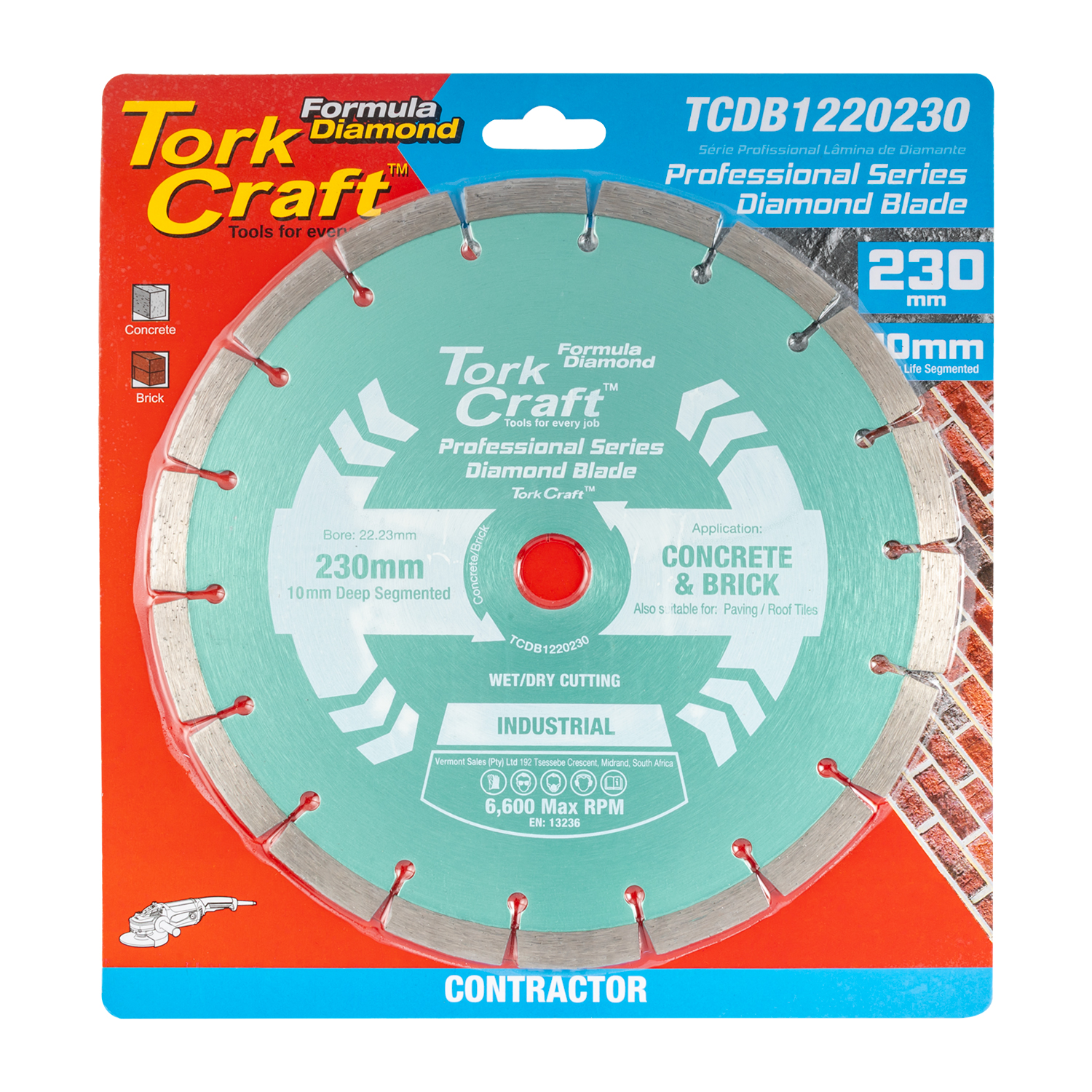
Tork Craft Diamond Blade 230Mm Segmented Hot Pressed
R545,22

TYPE:
Hot press and segmented.
DIAMETER: ø230mm
BORE: Ø22.23mm
MAX RPM: 6,600
USE: Brick, concrete, cement block, granite, fiber cement,
stone and other masonry
What is a diamond blade?
A diamond blade is composed of a circular steel core and the diamond
impregnated segments. The segments are seperated by slots in the core.
These
slots assist in cooling the blade during operation by allowing water (wet
cutting) or air (dry cutting) to flow between the segments. The segments or rims
are a mixture of diamond powder and metal powders. The diamonds are industrial
diamonds of different sizes and qualities depending on the material to be cut as
well a the blade type.
How does a diamond blade work?
 The individual diamond crystals exposed on the leading edge and the sides of
the segment or rim carry out the cutting. The operator pushes the rotating blade
into the material and the surface diamonds thus exposed mill a groove in the
material. When the blade mills the material, the latter exerts wear on the
blade. During cutting the exposed diamonds may crack
or break. The material simultaneously starts to abrade the metal matrix, which
releases more diamonds.
 The more abrasive the material, the more rapid
the tendency to wear down the matrix. Blades for cutting hard, denseless
abrasive materials (such as tile, bricks, stone or cured concrete), require
a softer metal matrix.
This will wear down faster, replacing the worn diamonds
fairly quickly so that the blade continues to cut.
Blades for cutting soft,
abrasive materials (such as green concrete and asphalt), must have a hard,
abrasion-resistant metal matrix in order to retain the diamonds for a longer
time.
Water will prevent the blade from overheating:
It will greatly reduce the amount of harmful dust created by cutting. Remove the
slurry from the cut, and extend the life of the blade.
Free shipping on orders over R2000!
- Satisfaction Guaranteed
- Quality Spares, Accessories & Tools
- Secure Payments
Description
TYPE:
Hot press and segmented.
DIAMETER: ø230mm
BORE: Ø22.23mm
MAX RPM: 6,600
USE: Brick, concrete, cement block, granite, fiber cement,
stone and other masonry
What is a diamond blade?
A diamond blade is composed of a circular steel core and the diamond
impregnated segments. The segments are seperated by slots in the core.
These
slots assist in cooling the blade during operation by allowing water (wet
cutting) or air (dry cutting) to flow between the segments. The segments or rims
are a mixture of diamond powder and metal powders. The diamonds are industrial
diamonds of different sizes and qualities depending on the material to be cut as
well a the blade type.
How does a diamond blade work?
The individual diamond crystals exposed on the leading edge and the sides of
the segment or rim carry out the cutting. The operator pushes the rotating blade
into the material and the surface diamonds thus exposed mill a groove in the
material. When the blade mills the material, the latter exerts wear on the
blade. During cutting the exposed diamonds may crack
or break. The material simultaneously starts to abrade the metal matrix, which
releases more diamonds.
The more abrasive the material, the more rapid
the tendency to wear down the matrix. Blades for cutting hard, denseless
abrasive materials (such as tile, bricks, stone or cured concrete), require
a softer metal matrix.
This will wear down faster, replacing the worn diamonds
fairly quickly so that the blade continues to cut.
Blades for cutting soft,
abrasive materials (such as green concrete and asphalt), must have a hard,
abrasion-resistant metal matrix in order to retain the diamonds for a longer
time.
Water will prevent the blade from overheating:
It will greatly reduce the amount of harmful dust created by cutting. Remove the
slurry from the cut, and extend the life of the blade.
Different methods of making diamond blades:
Laser welding:
Laser micro-fusion enables the segment to be welded to the core. This bond is
the most powerful and enables the tool to be used for dry cutting and drilling
without segment loss.
Brazing:
Silver brazing solder melts at high temperaturs between the segment and the
core and binds the two elements together. Used for wet cutting, drilling and
grinding.
Cold sintering:
First pressed with a press machine under normal conditions, then laid in
sinter machine under high pressure and temperatures making the compressed metal
powder melt to a solid bond.
Hot pressed sintering:
Pressed with hot press machine under high temperature and pressure, making
the compressed metal powder melt to a solid bond.
Blade types:
Continuous smooth rim:
Provides the smoothest cut in ceramic tiles and ornamental stones.
Turbo/Segmented Turbo:
May produce slight chipping, but generally have a longer life and lower cost
per cut than continous rim blades.
Segmented:
Provide the longest life and lowest cost per cut, but are only suitable for
work where chipping is not a problem.
When cutting without water:
The blade should be allowed to cool off periodically. Cooling can be increased
by allowing the blade to spin freely out of the cut.
| consider safety for your health and the people around you |
|||
General safety suggestions:It is advisable to always have the following items nearby and in a good
|
|||
 |
 |
 |
 |
|
Wear Gloves
|
Eye Protection
|
Hearing Protection
|
Dust Mask
|
CAUTION:
Diamond blades are unable to withstand the forces involved at elevated
temperatures when cutting dry. It will be subject to rapid tool wear and
possible failure.
Additional information
| Weight | 0,64 kg |
|---|
Only logged in customers who have purchased this product may leave a review.


Reviews
There are no reviews yet.