Showing 17–32 of 40 resultsSorted by latest

  • Tork Craft Diamond Blade 300 X 25.4Mm Old Concrete Hot Pressed Segmented

    Tork Craft Diamond Blade 300 X 25.4Mm Old Concrete Hot Pressed Segmented

    R931,29

    Tork Craft Diamond Blade — 300 × 25.4 mm Hot-Pressed Segmented (Old/Cured Concrete)

    Size: 300 mm diameter [Bore: 25.4 mm (1″)]

    Purpose-built for old/cured concrete, this 300 mm Tork Craft diamond blade uses a hot-pressed segmented rim to maintain cutting speed and stability in dense, set substrates. The open gullet design clears abrasive fines and helps keep the blade cooler on longer passes—ideal for slab alterations, chase cuts and paver trimming.

    Note: Performs great with old/cured concrete surfaces

  • Tork Craft Diamond Blade 230Mm Segmented Laser Industrial

    Tork Craft Diamond Blade 230Mm Segmented Laser Industrial

    R921,30

    Diamond blade


    TYPE:

    Laser weld and industrial segmented.

    DIAMETER: ø230mm
    BORE: Ø22.23mm
    MAX RPM: 6,600
    USE: Marble, granite, concrete, masonry

    What is a diamond blade?

    A diamond blade is composed of a circular steel core and the diamond
    impregnated segments. The segments are seperated by slots in the core.

    These
    slots assist in cooling the blade during operation by allowing water (wet
    cutting) or air (dry cutting) to flow between the segments. The segments or rims
    are a mixture of diamond powder and metal powders. The diamonds are industrial
    diamonds of different sizes and qualities depending on the material to be cut as
    well a the blade type.

    How does a diamond blade work?

    The individual diamond crystals exposed on the leading edge and the sides of
    the segment or rim carry out the cutting. The operator pushes the rotating blade
    into the material and the surface diamonds thus exposed mill a groove in the
    material. When the blade mills the material, the latter exerts wear on the
    blade. During cutting the exposed diamonds may crack
    or break. The material simultaneously starts to abrade the metal matrix, which
    releases more diamonds.

    The more abrasive the material, the more rapid
    the tendency to wear down the matrix. Blades for cutting hard, denseless
    abrasive materials (such as tile, bricks, stone or cured concrete), require
    a softer metal matrix.

    This will wear down faster, replacing the worn diamonds
    fairly quickly so that the blade continues to cut.

    Blades for cutting soft,
    abrasive materials (such as green concrete and asphalt), must have  a hard,
    abrasion-resistant metal matrix in order to retain the diamonds for a longer
    time.

    Water will prevent the blade from overheating:

    It will greatly reduce the amount of harmful dust created by cutting. Remove the
    slurry from the cut, and extend the life of the blade.

  • Tork Craft Diamond Blade 230Mm Segmented Profesional Bulk 3 Pack Shrink

    Tork Craft Diamond Blade 230Mm Segmented Profesional Bulk 3 Pack Shrink

    R589,67

    Tork Craft Diamond Blade — 230 mm × Segmented Rim Bulk 3-Pack (Professional)

    Size: 230 mm diameter [Bulk 3-Pack]

    Designed for heavy-duty cutting tasks, this 230 mm diameter segmented-rim diamond blade from Tork Craft delivers fast, reliable performance in brick, block, concrete, masonry and stone applications. Supplied as a professional 3-blade bulk pack to keep your team moving with minimal downtime.

  • Tork Craft Diamond Blade 230Mm Segmented Hot Pressed

    Tork Craft Diamond Blade 230Mm Segmented Hot Pressed

    R545,22

    Diamond blade


    TYPE:

    Hot press and segmented.

    DIAMETER: ø230mm
    BORE: Ø22.23mm
    MAX RPM: 6,600
    USE: Brick, concrete, cement block, granite, fiber cement,
    stone and other masonry

    What is a diamond blade?

    A diamond blade is composed of a circular steel core and the diamond
    impregnated segments. The segments are seperated by slots in the core.

    These
    slots assist in cooling the blade during operation by allowing water (wet
    cutting) or air (dry cutting) to flow between the segments. The segments or rims
    are a mixture of diamond powder and metal powders. The diamonds are industrial
    diamonds of different sizes and qualities depending on the material to be cut as
    well a the blade type.

    How does a diamond blade work?

    The individual diamond crystals exposed on the leading edge and the sides of
    the segment or rim carry out the cutting. The operator pushes the rotating blade
    into the material and the surface diamonds thus exposed mill a groove in the
    material. When the blade mills the material, the latter exerts wear on the
    blade. During cutting the exposed diamonds may crack
    or break. The material simultaneously starts to abrade the metal matrix, which
    releases more diamonds.

    The more abrasive the material, the more rapid
    the tendency to wear down the matrix. Blades for cutting hard, denseless
    abrasive materials (such as tile, bricks, stone or cured concrete), require
    a softer metal matrix.

    This will wear down faster, replacing the worn diamonds
    fairly quickly so that the blade continues to cut.

    Blades for cutting soft,
    abrasive materials (such as green concrete and asphalt), must have  a hard,
    abrasion-resistant metal matrix in order to retain the diamonds for a longer
    time.

    Water will prevent the blade from overheating:

    It will greatly reduce the amount of harmful dust created by cutting. Remove the
    slurry from the cut, and extend the life of the blade.

  • Tork Craft Diamond Blade Continues Thin Rim 230X22.22Mm

    Tork Craft Diamond Blade Continues Thin Rim 230X22.22Mm

    R345,45
    Continious Thin Rim Diamond blade 230mm

    PROFESSIONAL

    For cutting ceramic tiles and natural stone slabs

    Professional Series Diamond Blade with Continuous Rim (non-segmented) for cutting
    ceramic tiles and natural stone slabs. Thin rim version. Standard 22.23mm bore size to fit all makes
    of angle grinders.

    The Continuous Rim blade is most commonly referred to as a wet cut blade. There
    are advantages to using water when cutting material:

    • Water significantly cools down the blade, allowing for longer service life
    • It flushes out any debris to lessen friction in the cutting zone
    • It reduces dust, thus preventing dust from building up in the vents of the
      tool, which would decrease its service life.

    The continuous rim cuts the slowest of any of the different styles of diamond
    cutting blades, but as a trade-off it produces the best cut. Typically, the continuous
    rim is used for cutting marble, granite, porcelain tile, and ceramic tile.

  • Tork Craft Diamond Blade Turbo 230Mm

    Tork Craft Diamond Blade Turbo 230Mm

    R301,65

    Diamond blade


    TYPE:

    Turbo wave.

    DIAMETER: ø230mm
    BORE: Ø22.23mm
    MAX RPM: 6,600
    USE: Marble, granite, concrete, masonry

    What is a diamond blade?

    A diamond blade is composed of a circular steel core and the diamond
    impregnated segments. The segments are seperated by slots in the core.

    These
    slots assist in cooling the blade during operation by allowing water (wet
    cutting) or air (dry cutting) to flow between the segments. The segments or rims
    are a mixture of diamond powder and metal powders. The diamonds are industrial
    diamonds of different sizes and qualities depending on the material to be cut as
    well a the blade type.

    How does a diamond blade work?

    The individual diamond crystals exposed on the leading edge and the sides of
    the segment or rim carry out the cutting. The operator pushes the rotating blade
    into the material and the surface diamonds thus exposed mill a groove in the
    material. When the blade mills the material, the latter exerts wear on the
    blade. During cutting the exposed diamonds may crack
    or break. The material simultaneously starts to abrade the metal matrix, which
    releases more diamonds.

    The more abrasive the material, the more rapid
    the tendency to wear down the matrix. Blades for cutting hard, denseless
    abrasive materials (such as tile, bricks, stone or cured concrete), require
    a softer metal matrix.

    This will wear down faster, replacing the worn diamonds
    fairly quickly so that the blade continues to cut.

    Blades for cutting soft,
    abrasive materials (such as green concrete and asphalt), must have  a hard,
    abrasion-resistant metal matrix in order to retain the diamonds for a longer
    time.

    Water will prevent the blade from overheating:

    It will greatly reduce the amount of harmful dust created by cutting. Remove the
    slurry from the cut, and extend the life of the blade.

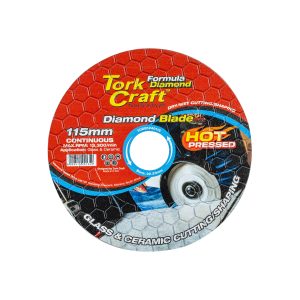
  • Tork Craft Diamond Blade 115Mm Honeycomb Glass & Tile Hot Pressed Industrial

    Tork Craft Diamond Blade 115Mm Honeycomb Glass & Tile Hot Pressed Industrial

    R299,00


    Diamond Blade

    Diameter: Ø115mm
    Arbor: Ø22.23mm
    Blade Type: Continuous rim with honeycomb design

    This Diamond Blade is a specialized cutting tool designed for precision work on glass and ceramic tiles. Its 115mm
    diameter and honeycomb structure provide efficient cooling and dust extraction, while the hot-pressed industrial
    diamond segments ensure a clean, accurate cut. This blade is ideal for professionals who require a reliable and durable
    tool for various glass and tile cutting applications.

    Application:

    • Used to cut glass and tiles.
    • Can be used in both dry and wet cutting depending on the machine used.
      However wet cutting is recommended because:

      • Water cools down the blades, which leads to longer life.
      • Water flushes any debris in the cutting zone thereby reducing friction.
      • Reduces dust which in turn increases service life for the tool.
    • Manufacturing
    • Construction
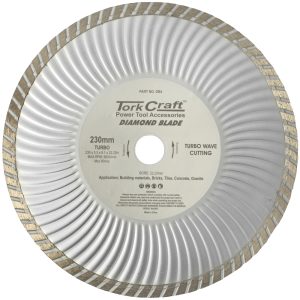
  • Tork Craft Diamond Blade 230Mm Turbo Wave Profesional

    Tork Craft Diamond Blade 230Mm Turbo Wave Profesional

    R292,90

    Tork Craft Diamond Blade — 230 × 22.23 mm Turbo-Wave (Professional)

    Size: 230 mm diameter [Bore: 22.23 mm]

    This 230 mm Tork Craft Turbo-Wave diamond blade combines the speed of a turbo rim with the smoother cut profile of a wave core. Suited to masonry, concrete, stone, tile, and block-work in professional and trade environments.

  • Tork Craft Diamond Blade Turbo-Segmented 230X22.23Mm

    Tork Craft Diamond Blade Turbo-Segmented 230X22.23Mm

    R273,75

    Tork Craft Diamond Blade — 230 × 22.23 mm Turbo-Segmented

    Size: 230 mm diameter [Bore: 22.23 mm]

    Designed for versatile site use, this 230 mm Tork Craft blade features a turbo-segmented rim that combines the speed of a turbo rim with the aggressive cutting action of a segmented blade. It excels in masonry, concrete block, stone and other building materials where fast removal and durability matter.

  • Tork Craft Diamond Blade 115Mm Turbo Segmented Laser Welded Industrial

    Tork Craft Diamond Blade 115Mm Turbo Segmented Laser Welded Industrial

    R270,00

    Diamond blade


    TYPE:

    Laser welded and turbo segmented.

    DIAMETER: ø115mm
    BORE: Ø22.23mm
    MAX RPM: 13,000
    USE: Marble, granite, concrete, masonry

    What is a diamond blade?

    A diamond blade is composed of a circular steel core and the diamond
    impregnated segments. The segments are seperated by slots in the core.

    These
    slots assist in cooling the blade during operation by allowing water (wet
    cutting) or air (dry cutting) to flow between the segments. The segments or rims
    are a mixture of diamond powder and metal powders. The diamonds are industrial
    diamonds of different sizes and qualities depending on the material to be cut as
    well a the blade type.

    How does a diamond blade work?

    The individual diamond crystals exposed on the leading edge and the sides of
    the segment or rim carry out the cutting. The operator pushes the rotating blade
    into the material and the surface diamonds thus exposed mill a groove in the
    material. When the blade mills the material, the latter exerts wear on the
    blade. During cutting the exposed diamonds may crack
    or break. The material simultaneously starts to abrade the metal matrix, which
    releases more diamonds.

    The more abrasive the material, the more rapid
    the tendency to wear down the matrix. Blades for cutting hard, denseless
    abrasive materials (such as tile, bricks, stone or cured concrete), require
    a softer metal matrix.

    This will wear down faster, replacing the worn diamonds
    fairly quickly so that the blade continues to cut.

    Blades for cutting soft,
    abrasive materials (such as green concrete and asphalt), must have  a hard,
    abrasion-resistant metal matrix in order to retain the diamonds for a longer
    time.

    Water will prevent the blade from overheating:

    It will greatly reduce the amount of harmful dust created by cutting. Remove the
    slurry from the cut, and extend the life of the blade.

  • Tork Craft Diamond Blade 200X25.4Mm Turbo

    Tork Craft Diamond Blade 200X25.4Mm Turbo

    R254,55

    Tork Craft Diamond Blade — 200 × 25.4 mm Turbo Rim

    Size: 200 mm diameter [Bore: 25.4 mm]

    This 200 mm Tork Craft Turbo rim diamond blade is designed for trades and general use. The turbo edge helps clear debris efficiently while maintaining cutting speed, making it ideal for tile, masonry, stone and concrete applications. The 25.4 mm bore ensures compatibility with standard handheld and bench saws.

  • Tork Craft Diamond Blade 230Mm Continuous Rim

    Tork Craft Diamond Blade 230Mm Continuous Rim

    R254,55

    Diamond blade


    TYPE:

    Continuous rim.

    DIAMETER: ø230mm
    BORE: Ø22.23mm
    MAX RPM: 6,600
    USE: Marble, granite, concrete, masonry

    What is a diamond blade?

    A diamond blade is composed of a circular steel core and the diamond
    impregnated segments. The segments are seperated by slots in the core.

    These
    slots assist in cooling the blade during operation by allowing water (wet
    cutting) or air (dry cutting) to flow between the segments. The segments or rims
    are a mixture of diamond powder and metal powders. The diamonds are industrial
    diamonds of different sizes and qualities depending on the material to be cut as
    well a the blade type.

    How does a diamond blade work?

    The individual diamond crystals exposed on the leading edge and the sides of
    the segment or rim carry out the cutting. The operator pushes the rotating blade
    into the material and the surface diamonds thus exposed mill a groove in the
    material. When the blade mills the material, the latter exerts wear on the
    blade. During cutting the exposed diamonds may crack
    or break. The material simultaneously starts to abrade the metal matrix, which
    releases more diamonds.

    The more abrasive the material, the more rapid
    the tendency to wear down the matrix. Blades for cutting hard, denseless
    abrasive materials (such as tile, bricks, stone or cured concrete), require
    a softer metal matrix.

    This will wear down faster, replacing the worn diamonds
    fairly quickly so that the blade continues to cut.

    Blades for cutting soft,
    abrasive materials (such as green concrete and asphalt), must have  a hard,
    abrasion-resistant metal matrix in order to retain the diamonds for a longer
    time.

    Water will prevent the blade from overheating:

    It will greatly reduce the amount of harmful dust created by cutting. Remove the
    slurry from the cut, and extend the life of the blade.
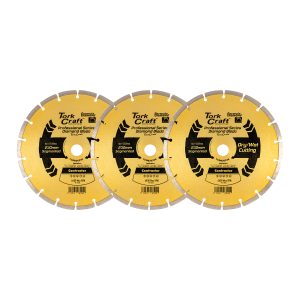
  • Tork Craft Diamond Blade 230Mm X 25.4 Continues Rim

    Tork Craft Diamond Blade 230Mm X 25.4 Continues Rim

    R237,85
    Continious Rim Diamond blade 230mm

    PROFESSIONAL

    For cutting ceramic tiles and natural stone slabs

    Professional Series Diamond Blade with Continuous Rim (non-segmented) for cutting
    ceramic tiles and natural stone slabs. 25.4mm bore size.

    The Continuous Rim blade is most commonly referred to as a wet cut blade. There
    are advantages to using water when cutting material:

    • Water significantly cools down the blade, allowing for longer service life
    • It flushes out any debris to lessen friction in the cutting zone
    • It reduces dust, thus preventing dust from building up in the vents of the
      tool, which would decrease its service life.

    The continuous rim cuts the slowest of any of the different styles of diamond
    cutting blades, but as a trade-off it produces the best cut. Typically, the continuous
    rim is used for cutting marble, granite, porcelain tile, and ceramic tile.

  • Tork Craft Diamond Blade 200Mm X 22.22 Continues Rim

    Tork Craft Diamond Blade 200Mm X 22.22 Continues Rim

    R237,85
    Continious Rim Diamond blade 200mm

    PROFESSIONAL

    For cutting ceramic tiles and natural stone slabs

    Professional Series Diamond Blade with Continuous Rim (non-segmented) for cutting
    ceramic tiles and natural stone slabs. Standard 22.23mm bore size to fit all makes
    of angle grinders.

    The Continuous Rim blade is most commonly referred to as a wet cut blade. There
    are advantages to using water when cutting material:

    • Water significantly cools down the blade, allowing for longer service life
    • It flushes out any debris to lessen friction in the cutting zone
    • It reduces dust, thus preventing dust from building up in the vents of the
      tool, which would decrease its service life.

    The continuous rim cuts the slowest of any of the different styles of diamond
    cutting blades, but as a trade-off it produces the best cut. Typically, the continuous
    rim is used for cutting marble, granite, porcelain tile, and ceramic tile.

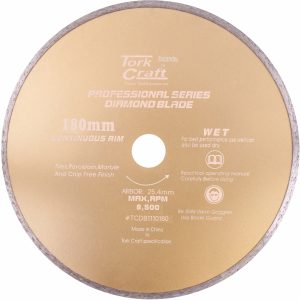
  • Tork Craft Diamond Blade 180Mm X 25.4 Continues Rim

    Tork Craft Diamond Blade 180Mm X 25.4 Continues Rim

    R216,20
    Continuous Rim Diamond blade 180mm

    PROFESSIONAL

    For cutting ceramic tiles and natural stone slabs

    Professional Series Diamond Blade with Continuous Rim (non-segmented) for cutting
    ceramic tiles and natural stone slabs. 25.4mm bore size to specific machines

    The Continuous Rim blade is most commonly referred to as a wet cut blade. There
    are advantages to using water when cutting material:

    • Water significantly cools down the blade, allowing for longer service life
    • It flushes out any debris to lessen friction in the cutting zone
    • It reduces dust, thus preventing dust from building up in the vents of the
      tool, which would decrease its service life.

    The continuous rim cuts the slowest of any of the different styles of diamond
    cutting blades, but as a trade-off it produces the best cut. Typically, the continuous
    rim is used for cutting marble, granite, porcelain tile, and ceramic tile.

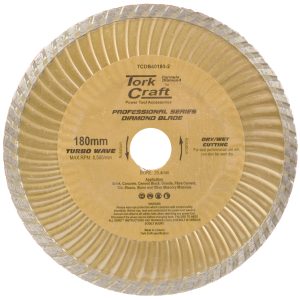
  • Tork Craft Diamond Blade 180X22.22Mm Turbo Wave

    Tork Craft Diamond Blade 180X22.22Mm Turbo Wave

    R203,40

    Tork Craft Diamond Blade — Turbo-Wave 180 × 22.23 mm

    Size: 180 mm diameter [Bore: 22.23 mm]

    This 180 mm Tork Craft Turbo-Wave diamond blade delivers high-speed performance and precision. Its serrated turbo rim and wave-core body enhance airflow, helping the blade stay cool and clean while maintaining cutting efficiency. Perfect for brick, concrete, stone, tiles, and general masonry work.